
Capital city on the Kansas River
Epoxy Flooring in Topeka, KS
Garage, basement and shop floors for a city where most houses were built before 1970.
- Free on-site estimates with a slab moisture check
- Itemized written quote before any work starts
- Full diamond grinding and crack repair under every coating
Topeka Floors, Neighborhood by Neighborhood
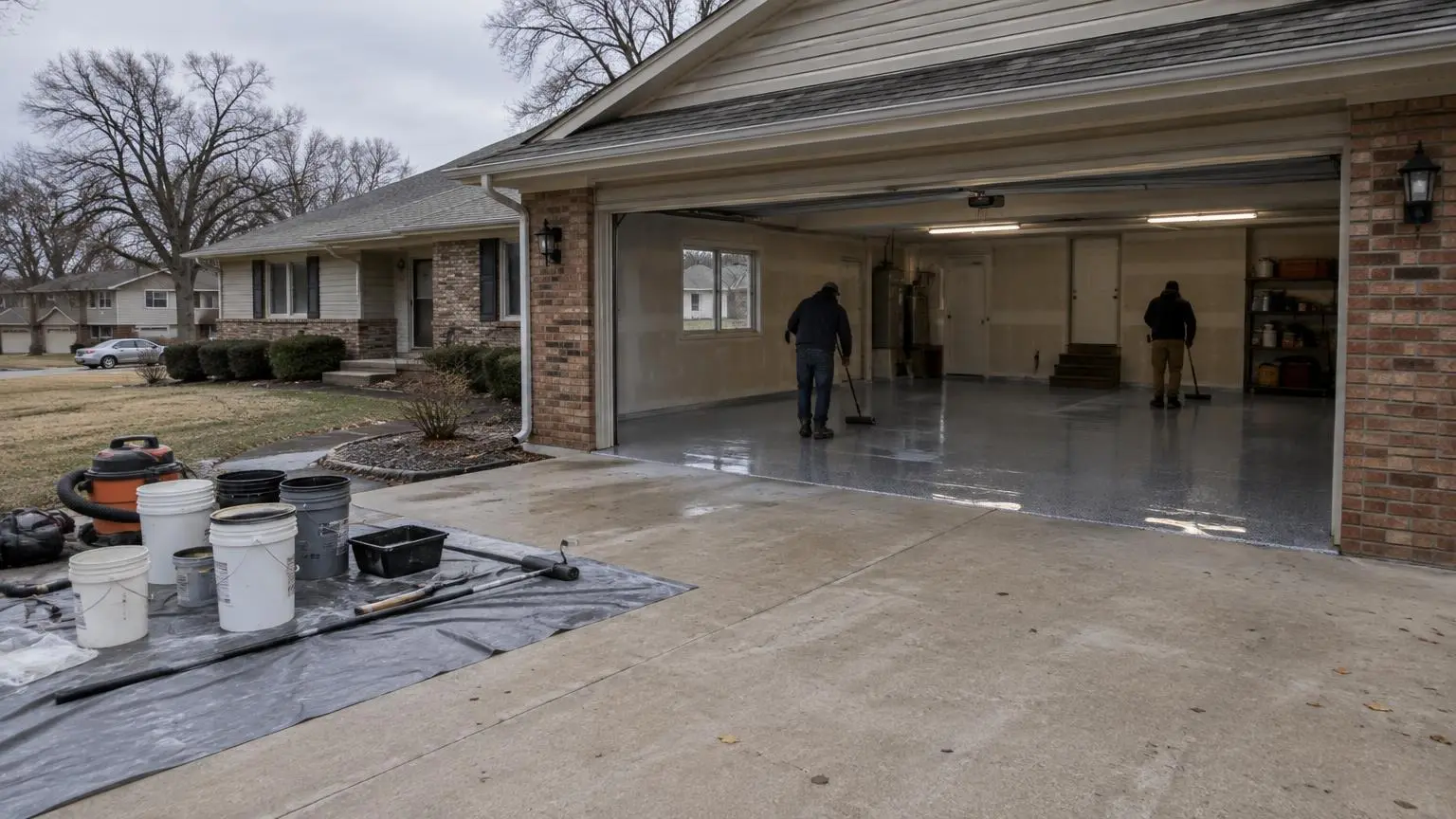
Epoxy flooring in Topeka is mostly work on concrete that already has a long history. American Community Survey estimates for 2019 to 2023 count 59,868 housing units in the city, and only 4.4% of them were built in 2010 or later. So the slab we are asked to coat is usually decades old. It may have been painted twice, patched once and parked on by three or four owners. Our job is to find out what is on it, take that off, fix what is broken and then build a floor that fits how you use the room.
Three kinds of Topeka garage we see most
- Pre-war detached garages. About 16.2% of Topeka homes date from 1939 or earlier. Garages from that era are often narrow, sit at the back of the lot and have thin slabs that have settled at the door. Many were poured or replaced long after the house went up.
- Mid-century attached garages. The 1950s and 1960s together account for about 31% of the city's housing. These are the one- and two-car garages on ranch and split-level houses across west and south Topeka. Their slabs tend to carry old paint, oil and a worn apron.
- Newer two- and three-car garages. Houses built since the 1990s make up a smaller share. Their slabs are usually flat and sound but troweled very smooth, and a coating will not hold on that surface until it is ground open.
Older streets: Potwin Place, Oakland and Tennessee Town
Some of Topeka's oldest neighborhoods still show their age at street level. Potwin Place was split into 80 lots in 1882, became its own small city in 1888 and was annexed by Topeka in 1899. It is known for its brick streets and was added to the National Register of Historic Places in 1980. In areas like Potwin, Oakland and the blocks around Tennessee Town, garage and basement floors are often a patchwork of eras. One section may be original and another poured decades later, with a step or seam where they meet. We grind across those seams, fill the joint and level low spots so the finished coating reads as one floor.
Houses rebuilt after June 8, 1966
The tornado that crossed Burnett's Mound on June 8, 1966 ran about 22 miles through the city with a path roughly half a mile wide. It destroyed 820 homes and damaged 3,000 more, and it hit Washburn University and downtown directly. Many houses along that path were repaired or rebuilt in the late 1960s, so a single block can mix original slabs with ones poured after the storm. Two floors on the same street may need very different prep. That is one reason we will not quote a Topeka floor from a photo alone.
Owners, landlords and the 2.21-person household
Census QuickFacts puts Topeka's owner-occupied rate at 59.0% for 2020 to 2024, so about four in ten homes are rentals. Average household size is 2.21 people. In practice that means a lot of one- and two-car garages, and a steady number of landlords who want a basement or garage floor that cleans up quickly between tenants. For rentals we usually suggest a solid-color or light flake system. It hides wear, it does not hold odors the way bare concrete does, and a damaged area can be ground out and patched later. Owners staying put often go further: a full flake garage, a polyaspartic topcoat for a faster return to use, or a metallic floor in a finished basement.
What we look at before we price a Topeka floor
- Old paint, sealer or a past DIY kit that must come off
- Oil and transmission fluid soaked in near the parking spots
- Cracks, spalls and a settled apron at the overhead door
- Moisture in basement slabs after the wet months; May and June are Topeka's rainiest, at 5.17 and 4.92 inches on average
- Seams between old and newer concrete pours
- How you use the space: two cars, a workshop, storage, a gym or a laundry room
Basements under older Topeka houses
A large share of houses built before 1970 have full or partial basements. Those slabs were rarely poured over a vapor barrier, so moisture can move up through the concrete after a wet spring. We test before we coat. A dry slab takes a standard primer and a basement floor epoxy system. A damp one gets a primer made for moisture, and a slab with water coming through cracks gets a frank note that the leak comes first. We also remind owners finishing a basement to test for radon, because a coating does not stop it.
Matching the system to the room
- Detached and older garages: garage floor coating with a full flake broadcast, which hides the uneven color left after crack repair.
- Daily-driver attached garages: epoxy base with a polyaspartic topcoat, so the floor is back in service sooner.
- Finished basements: basement floor epoxy over a moisture-tested slab, or metallic epoxy for a family room or bar.
- Home and business shops: commercial and shop floor epoxy built thicker for rolling jacks, parts carts and spilled fluids.
Call (785) 508-1522 or
and we will come out, measure and test your floor, and give you a written quote.Topeka Facts That Shape the Floor
- An older housing stock. ACS estimates for 2019 to 2023 put the median year built at 1967. 16.2% of homes date from 1939 or earlier and 16.4% from the 1950s, while only 4.4% were built in 2010 or later.
- Potwin Place. Charles Potwin divided the land into 80 lots in 1882. The area became the City of Potwin in 1888, joined Topeka in 1899 and was listed on the National Register of Historic Places in 1980.
- The 1966 tornado. The June 8, 1966 tornado traveled about 22 miles through Topeka, destroying 820 homes and damaging 3,000, along with Washburn University and parts of downtown.
- Owners and renters. Census QuickFacts lists a 59.0% owner-occupied rate, a median owner-occupied home value of $144,200 and 2.21 persons per household for 2020 to 2024.
Topeka Questions
My Topeka garage floor has two different concrete pours. Can it still be coated?
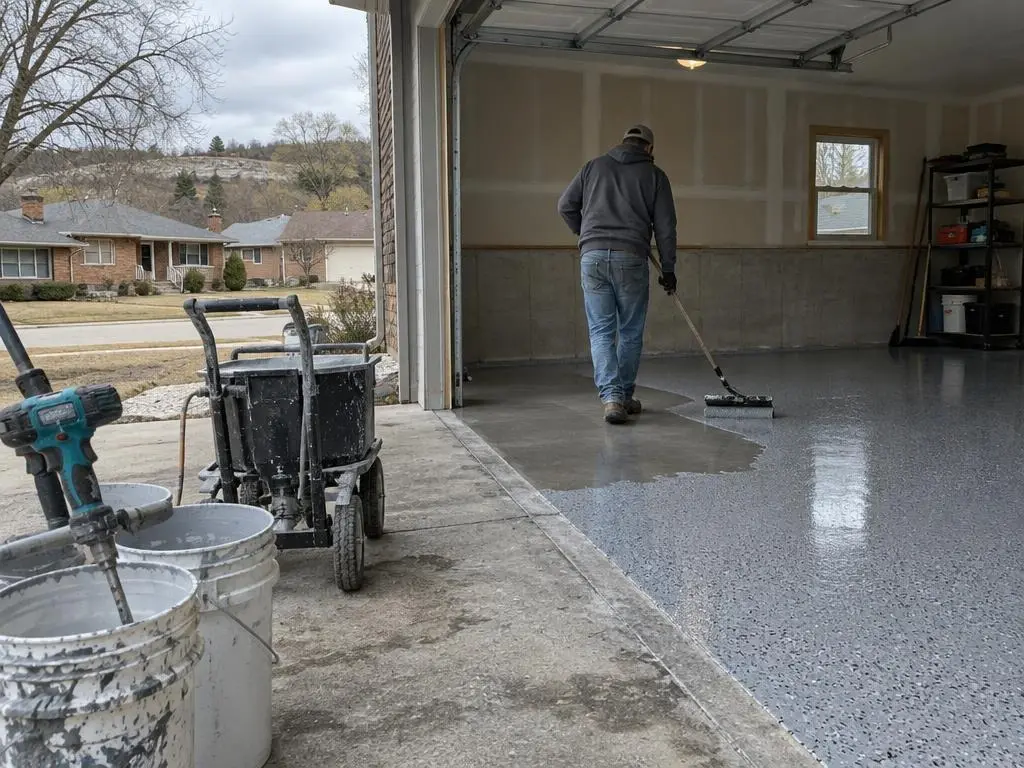
Yes, in most cases. We grind both sections, fill the seam or keep it as a control joint, and level any step between them. A flake broadcast helps blend the two areas. If one section is moving or cracking through, we point that out before you commit to a coating.
Is epoxy a good choice for a Topeka rental property?
It can be. A coated garage or basement floor is easier to clean between tenants, and a solid color or light flake hides normal wear. Because about 41% of Topeka homes are rented, we price rental floors often and can keep the system simple to fit the budget.
I live in Potwin Place. Does a garage floor coating need historic review?
A floor coating is interior work and does not change the outside of the building. If your project also touches the garage door, siding or windows, check with the City of Topeka about any review before that part starts. Our quote lists the floor work on its own.
Free Estimates in Topeka, KS
Free on-site estimates anywhere in Topeka, from Potwin to the south side.
Epoxy Flooring Near Topeka
- Epoxy Flooring in Tecumseh, KS
- Epoxy Flooring in Berryton, KS
- Epoxy Flooring in Silver Lake, KS
- Epoxy Flooring in Meriden, KS
- Epoxy Flooring in Auburn, KS
- Epoxy Flooring in Hoyt, KS
- Epoxy Flooring in Rossville, KS
- Epoxy Flooring in Perry, KS
- Epoxy Flooring in Carbondale, KS
- Epoxy Flooring in Ozawkie, KS
- Epoxy Flooring in Maple Hill, KS
- Epoxy Flooring in Mayetta, KS
- Epoxy Flooring in Overbrook, KS
- Epoxy Flooring in St. Marys, KS
- Epoxy Flooring in Burlingame, KS
- Epoxy Flooring in Oskaloosa, KS
- Epoxy Flooring in Valley Falls, KS
- Epoxy Flooring in Holton, KS
- Epoxy Flooring in Osage City, KS